Tuesday, October 10, 2006

People power 2.0 not technology

The perception that technology is driving change in communications is wrong – it is the audience that is changing, says Aedhmar Hynes CEO of independent PR firm Text 100 International.

Hynes was in Singapore for a one-day stopover and spoke to a select group of 13 CEOs and senior marketers at an event sponsored by Text 100 and hosted by Marketing magazine last evening. The event was held to give a small group of Singapore’s marketing elite (think Nike, BMW, Google, Jetstar, Bang and Olufsen and Philips just for starters) the opportunity to meet a genuine global leader in business communications.
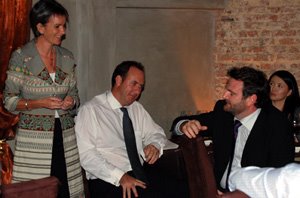

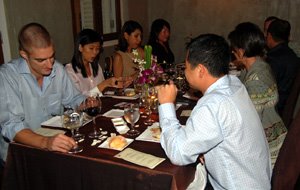
“We’re living in the world of change – our people are changing and technology is enabling that change, and more tools are emerging in response to change,” Hynes says.

In line with her observation, Hynes started blogging earlier this year to be able to “understand what it feels like, what the considerations are”, so she can better advise clients on it. She feels anyone born before 1975 can be termed “digital immigrants”, while those born after are “digital natives” and thus the immigrants need to work harder to understand new communications tools.

She says no company should start by saying “we need a blog”; instead, it has to ask itself what it wants to achieve and if having a blog will be beneficial.

“With blogging, you’re going to attract attention and it may not all be welcome so you’ve got to understand it,” she says.

According to her, there are three issues surrounding the changing audience. The first is trust, ie. the erosion of institutional trust – people more likely to trust info coming from their peer groups.

Secondly, there’s media fragmentation – previously, we watched prime time TV and read the same newspapers; now, we get news from different places and we want news at our own time, in the format we prefer.

Lastly, people nowadays are empowered to create content and respond to views from others and so proximity between brand and customer is one to one – “the right of reply is immediate”, which leads to crisis management issues.

Under Hynes’s leadership, Text 100 has grown its position as a leader in global communications and is a thought partner for almost 300 clients across the world. She oversees annual revenues of US$60 million, a staff of over 500, and 30 offices spanning North America, Asia Pacific, and Europe. She is based in New York City and works directly with many of the company’s key accounts such as IBM, Xerox, Philips, and Fujifilm.

She recently over saw Text 100’s entry into Second Life, making it the first global PR firm to establish a presence inside the rapidly growing virtual world.

Monday, October 09, 2006

Crowing about the Crowbar Awards

I did not feel like going to the Crowbar Awards on Friday night because I was in TGIF mode by the time my work day finished but I am glad I went. It was my first time going and the show was long…really long but a good host, some good speeches and good work made for an interesting and yet un-interesting evening as well.


(L-R: Anthony Kang, president of the 4As presenting the Overall Best of Show Award to a Media Design School, New Zealand team representative)

(Overall Best of Show Award for'McCoys-Never water down a good thing' by Neil Williamson and Rachel Walker)

I was outside the NTUC Auditorium around 6.45pm and had to take the glass lift up to the seventh floor, somehow I was able to stay calm even when I was staring right out the glass, my fear of heights disappeared as the smoky hazed sky totally blocked everything out.

When I reached the auditorium, I ‘checked in’ and got my ticket for the buffet and seating arrangement sorted out, was not hungry so I went to check out the entries on display.
(Best of Category Gold for Film, 'Hollow' by Shi Ming Ming and Yang Lin from Nanyang Academy of Fine Arts)

Once in the display area, I looked around for important marketers to photograph, so I could fill our November issue’s events page spread but at 7pm, there were mostly students just hanging around, showing off their work. I took some pictures of their work and overall I was impressed at the quality.

Now I waited for any ‘adults’ to show up so I could ask them, “Hey you’re not a student right? What are you doing here and where are you from? My name’s Marcus from Marketing magazine…blah blah blah, can I get a picture?”
(Best of Category Gold for Photography, 'SKWIDD' by Cheong Meng Kwong, Ivan)


Hour’s later (ok maybe it was more like hour+++) I had a few good pictures and had continued my slow process of introducing myself to the industry as the new guy on Marketing’s block.

It started getting late so I went to take my seat which was right at the front and next to Carissa or was it Clarissa (didn’t catch her last name) and after chatting with her she told me that she was the host and I should get comfortable because it might be a long show. Oh well, I guess I should have eaten something at the buffet after all, at least the seats were comfortable though.

A couple of good speeches later, namely by Calvin Soh and Farrokh Madon, who are co-chairmen of this year’s Crowbar Awards, the celebration of the work began.

As with the norm of all award shows, there were too many awards but the host kept things lively enough and I can honestly say most of the work was of a high quality so a bronze for this and a bronze for that could be well deserved acknowledgement in retrospect.

Aside from the quality work I was also expecting to see more attitude and character on stage especially after Calvin Soh’s speech about swagger etc, and the fact that these are creative students here tonight. I kept on imagining a guy with a Mohawk running on stage, celebrating his victory with yelling and screaming and punches in the air. That guy never showed up…I guess he failed his copywriting class.

Thursday, October 05, 2006

Another round of sangria for the team please!

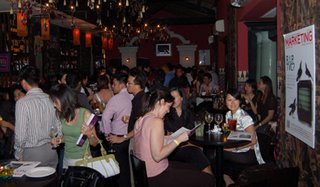
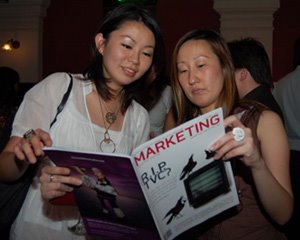
Thank you so much to friends who turned up to celebrate Marketing’s redesign launch with us last night at Chijmes. It was one heck of a party, and was absolutely lovely to be surrounded by people whom we like and are the reason we exist.

We’ve been around for 4.5 years now and it’s high time we rewarded our loyal readers with a refreshed product with improved content, easier navigation, a more attractive layout, a more modern feel and vibrant colours to match.

So we pooled our resources and planned for about three months, spent about three weeks intensively putting the content and design together, and it all culminated in a bash last night where we unveiled a very very very hot looking magazine.


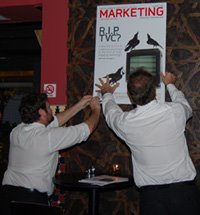
No, no no, it should be further left!

About 120 of you clicked glasses with us and shared feedback on the new look which we are very grateful for. I have to say that a few people whom we really wanted to party with did not receive our email invites (technology will let you down, it’s Murphy’s Law) and I’m sorry about that, and we wish you were there.

The Lighthouse ladies

You’ll receive your copy in the mail from next week and our phonelines/emails are open so do send us your thoughts on it.

Kudos to my team for the excellent work… it was great learning for all of us eh!

Hey bosses, may we have the rest of the month off? Pretty please?

(Confidential) Guess who don't sue, the joke's on us:

  1. Did you get a glimpse of Lighthouse’s very own New Paper beauty queen Jacqueline Thibodeaux? From what I noticed, a few members of the opposite sex kept her in close sight all evening.
  2. Which Marketing mag ace ad sales person had her mother call the office this morning on her behalf as she was hung over and had to stay home?
  3. Which (same) sales person stayed at the party till 3.30am and kept falling down stairs?
  4. Which (two) Lighthouse bosses were telling old-man stories towards the end of the night as a result of their getting over-familiar with the sangria?
  5. Which (two) Lighthouse colleagues showed up at work today in the same glamourous outfits they wore last night?
  6. Which Lighthouse ad sales person puked into her handbag at Bugis MRT station this morning?
  7. Which Lighthouse editorial person, also under the effects of sangria, thought she was a diva and kept making dramatic poses all evening?

If you’re wondering why we’re sharing such embarrassing happenings in such a public space, we say, “Come on, share a laugh with us!”

Wednesday, October 04, 2006

It’s not enough to satisfy your customers

Guess what? These days it’s not enough to ensure customer satisfaction – if you want loyal customers (read: higher profit margins), you’ve also got to make sure you appeal to their rational and emotional levels.

At least that was the message of a breakfast briefing organised by market research firms Harris Interactive and Market Share.

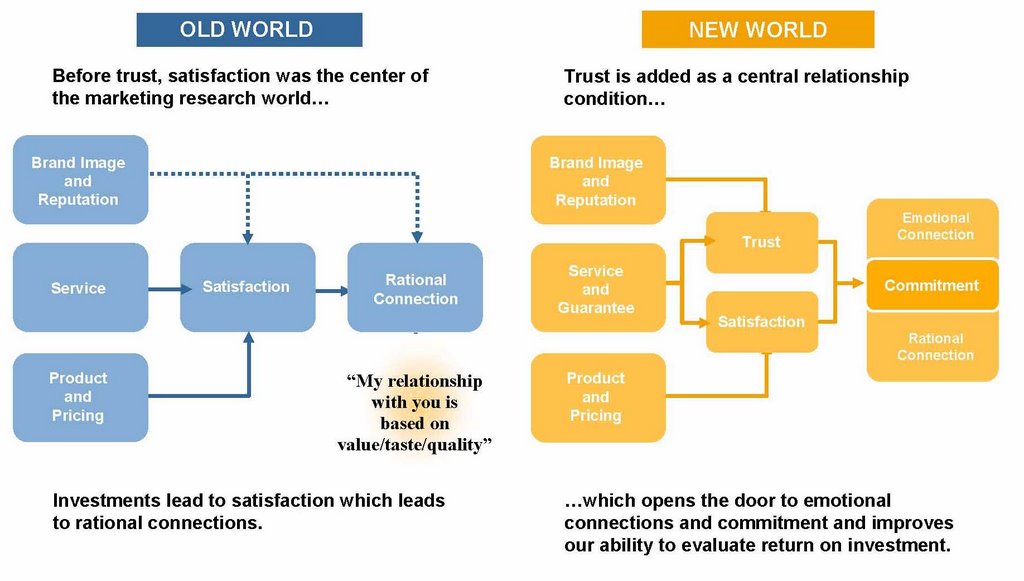
According to a study they did, customer loyalty can be nurtured through building trust together with satisfaction – in a nutshell, if companies can get customers to trust them and believe that the product they’re paying for is value for money, this creates an emotional connection between customers and brands, thereby increasing the level of commitment. This trust-based commitment then has the potential to translate into monetary returns for companies, as these consumers are more price-insensitive. This means even if you raise prices, they’ll still buy your product(s).


(Ok, I know you can't really see the above diagram but that's the best I've got.) There’s a lot more to the study but this is the fundamental point. I could be wrong but at the briefing, it seemed as though the hosts were delivering their new findings to a slightly skeptical crowd and it was easy to see why as the concept of customer satisfaction has been central to the marketing research community for a long time. During the Q&A session for instance, one participant questioned the disconnect between trust and satisfaction, while another raised the issue of the risk of basing a business model on trust, because once broken, is something that is very hard to repair.

The briefing facilitators though handled the queries well – with the first question it was explained that there’s no disconnect at all as trust was merged together with the old customer satisfaction model; all the study did was to uncover the element and stretch the pic. As for the risk of trust, it might be a case of consumers being more willing to forgive secondary mistakes, and allowing the brand a second chance at redeeming itself.

As a marketer, what do you think? Does trust have a place in your strategy?

Monday, October 02, 2006

Tell me the future for a piece of toast


The “future of communications in a connected world” that was the intriguing tag line that got me to attend Text 100’s recent breakfast briefing, the other reason I went? Free breakfast of course.

The talk happened about a week ago and leading the discussion was Georg Kolb, EVP for Text 100 New York and member of its executive leadership team. It was at a cosy little venue and so I went there at 8.45am optimistic about breakfast and actually very keen to hear what the “future of communications” was going to be; my mind still buzzing from the short video Text 100 sent us as part of the invite: (http://www.albinoblacksheep.com/flash/epic ).

If you have the time (it’s about five minutes long) watch it. It will get your taste buds set for the topic especially for those of you involved in a print publication which has online ambitions.
Back at the Text 100 briefing, I met a handful of people but I also managed to meet Georg Kolb and we started chatting about the topic and I tried to steer it towards a more Singapore or at least Asian perspective.

Off the top of my head I remember him saying the future of communications is about peer to peer platforms and he wished Singaporeans would think of peer to peer platforms beyond just blogs because they are so many other forms out there.

In fairness to those of us who do think this way, blogs are an obvious peer to peer platform to mention, for example if you took the time to view the short video which I recommended, well then that says a little something about the potential power of this peer to peer platform. Below are some links to blogs which were successful in using this peer to peer platform in the corporate world.

(IBM Corporate Blogging Programme) http://www-03.ibm.com/developerworks/blogs/

(Stonyfield Farm) http://www.stonyfield.com/weblog/

An example of a blog which was unsuccessful and has since been shut was one by Mazda. To enlighten yourself Google terms like Mazda Viral Marketing or Mazda Kid Halloween to find out more.

Kolb said in the briefing, “It’s about building peer referrals, people are empowered to find their peers and talk to them. People will no longer listen to a brand spokesperson who is always looking to push the brand; instead they are looking for a two way communication which will allow them to tell you what they think of the brand”.

Examples of the peer to peer platforms Kolb talks about include social networks (like MySpace), search engines and virtual life platforms, specifically Second Life. For those of you unfamiliar with Second Life, it is a virtual world on the internet where users, who are represented by 3D figures or avatars, can do everything from running businesses to having sexual liaisons.


At the briefing the importance of Second Life was debated and I got the impression not all were convinced the platform offered anything new, other than 3D imagery. Personally I think from the point of view of an internet user who sometimes struggles to keep up with the early adopters of today, it looks fantastic but how does it rate as a peer to peer platform? What is its Unique Selling Proposition to advertisers?

So as we come to the end of my blog entry, we are left with more questions than answers. I want to know, what my peers think the future of communications in a connected world is?
Hopefully not all of you will have read this entry and thought “what a load of crap I can’t believe I just wasted ten minutes of my life reading this, ten minutes which I will never get back, I hate you The Pitch and I hate you cruel connected world!”

That’s fine if you do though because we totally appreciate the way online works, and are prepared to get the criticism and praise which can come with a blog.